

Shadow work helps you look at feelings, habits, and parts of yourself that you find hard to accept. Maybe you keep replaying an awkward moment, judging yourself for a mistake, or reacting to the same situation again and again.
I work with these experiences in my own life and with clients. The goal is to understand what needs attention, decide what you can do, and give yourself room to move forward.
In this episode of 5D Channels & Chats, I share my approach to shadow work and finding more joy.
What Is Shadow Work?
Shadow work means exploring the parts of yourself you tend to hide, judge, or avoid. These might include anger, jealousy, shame, regret, or habits you wish you could change.
Sometimes, the part you struggle to accept isn’t something harmful at all. You might feel embarrassed about being enthusiastic, sensitive, outspoken, or different from the people around you.
The work is figuring out what needs to change, what needs care, and what you can learn to accept about yourself.
What Is Spiritual Bypassing?
Spiritual bypassing happens when spiritual ideas become a way to avoid difficult feelings or problems. Saying “love and light only” won’t resolve something that still needs your attention.
You can care about your spiritual growth and still feel angry, sad, or disappointed. Acknowledging those feelings gives you a place to begin.
You may need to apologize, set a boundary, change a habit, or ask for help. Spiritual practice can support those steps.

How Do You Recognize a Trigger?
A trigger is something that brings up a strong emotional reaction. It might be a comment, a memory, or a situation that reminds you of an earlier experience.
When you notice a reaction, pause and ask:
- What just happened?
- What am I feeling?
- Does this remind me of something?
- Is there a pattern here?
- What do I need right now?
You don’t have to answer every question immediately. Start with what you can recognize.
Acceptance: A Key Part of Shadow Work
One of the most important parts of this practice is accepting how you feel. This is something I learned from Eckhart Tolle’s book A New Earth, which changed my life decades ago. It’s a big part of how I approach shadow work.
In this moment, you only have to accept that you feel the way you do.
“I feel hurt, and that’s okay.”
“I feel embarrassed, and that’s okay.”
“I feel anxious about this, and that’s okay.”
You don’t have to figure out the whole situation or make the feeling disappear. Start by noticing it and allowing yourself to feel it without arguing with yourself about whether you should.
That acceptance can help create space between you and the intense emotion. You can notice the feeling without being completely caught up in it. The trigger may still be there, but you may find that the anxiety or emotional intensity begins to ease.
From that place, it becomes easier to understand what needs your attention and choose your next step. This is why accepting how you feel is such an important part of the eight-step practice below.
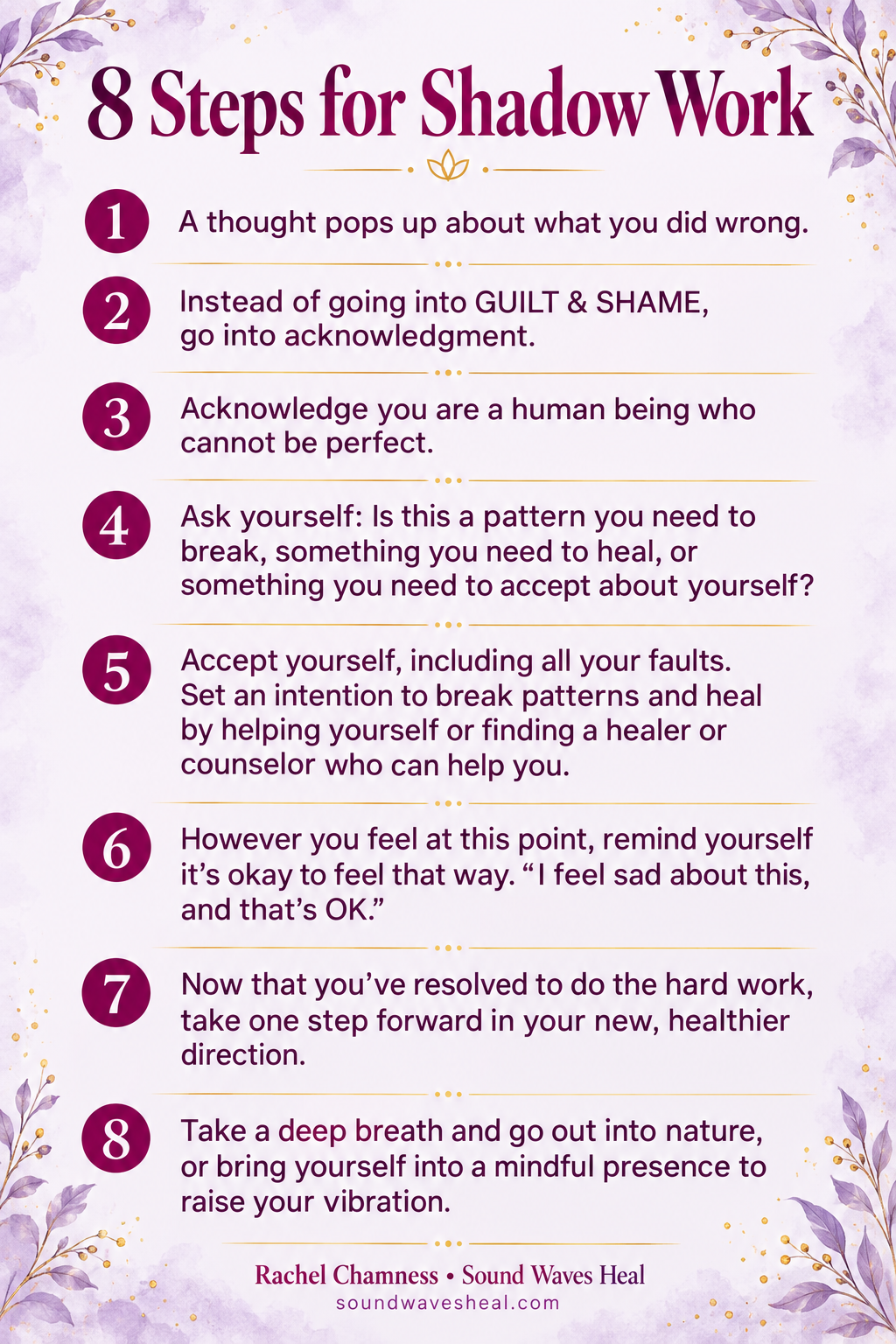
How Do You Do Shadow Work on Yourself?
Here is my eight-step process:
- A thought pops up about what you did wrong.
- Instead of going into GUILT & SHAME, go into acknowledgment.
- Acknowledge you are a human being who cannot be perfect.
- Ask yourself: Is this a pattern you need to break, something you need to heal, or something you need to accept about yourself?
- Accept yourself, including all your faults. Set an intention to break patterns and heal by helping yourself or finding a healer or counselor who can help you.
- However you feel at this point, remind yourself it’s okay to feel that way. “I feel sad about this, and that’s OK.”
- Now that you’ve resolved to do the hard work, take one step forward in your new, healthier direction.
- Take a deep breath and go out into nature, or bring yourself into a mindful presence to raise your vibration.
A Simple Example of Shadow Work
Imagine remembering a joke you made that sounded like an insult to a friend. You didn’t mean to hurt them, but you still feel embarrassed whenever you think about it.
Start by noticing how you feel: “I feel embarrassed about this, and that’s okay.”
You only have to accept how you feel in this moment. Give yourself a moment with that acceptance and notice whether the intensity begins to ease. This can help you step back from the emotion enough to look at what happened more clearly.
Then ask yourself: Is this a pattern I need to break, something I need to heal, or something I need to accept about myself?
Perhaps you often make jokes you later regret, and you want to change that habit. Perhaps being teased as a child makes this memory especially painful. Or perhaps you made one awkward comment and have been expecting yourself to never make a mistake.
Your next step depends on what you discover. You might apologize, seek help with an old hurt, or forgive yourself for an imperfect moment.
However you feel as you work through it, return to that acceptance: “This is how I feel, and that’s okay.” Then take one step forward and allow yourself to return to your day.

How Can You Release Shame During Shadow Work?
These are some practices I use alongside honest reflection and changes in behavior.
1. Practice Understanding and Self-Forgiveness
One thought helped me greatly when I began working on my shadows:
“I did the best I could, with what I knew at the time.”
Right now, you’re looking back at a time when you didn’t understand what you understand today. You’ve learned since then. You may also have been dealing with stress, grief, or more than you knew how to handle.
It’s easy to think, “I should have known better.” But did you know better then, or do you know better now?
You can take responsibility for what happened and still forgive yourself. Ask yourself what you would do differently today—and give yourself credit for what you’ve learned.
2. Practice Self-Forgiveness with Ho’oponopono
I use this four-phrase practice, commonly associated with modern Ho’oponopono, when working on self-forgiveness:
I love you.
I’m sorry.
Please forgive me.
Thank you.
I repeat these words while bringing my attention to my heart, my Higher Self, or a situation I’m working through. You can think of it as speaking gently to your own heart or self.
Self-forgiveness can take time. Here, you’re speaking to yourself and offering yourself forgiveness. You can acknowledge what happened, take responsibility where needed, and begin treating yourself with more kindness.
3. Try the Switchwords BOW–LOVE–RESTORE
I use Switchwords in my spiritual practice by speaking, chanting, or singing them. These are a type of supercharged affirmations.
One combination I use when working with shame is BOW–LOVE–RESTORE:
- BOW: I use this word with the intention of releasing shame. Pronounce it like taking a bow.
- LOVE: I focus on self-love.
- RESTORE: I focus on rebuilding confidence.
Try repeating the phrase for a minute or two and notice how it feels. You can use it as a reminder of the intention you’re working with. For more examples and ways to use them, read Supercharge Your Affirmations with Switchwords.
4. Get Support When You Need It
Some experiences are easier to explore with support. You don’t have to work through everything alone.
In my private sessions, I offer spiritual guidance and energy work to help clients explore what they’re experiencing and their next steps.
For trauma, ongoing distress, or concerns about your mental health, a licensed therapist can provide appropriate support. Spiritual practices can be part of caring for yourself alongside that work.
How Can You Make Shadow Work Easier?
Start with something manageable. You don’t have to begin with your most painful memory.
When a feeling comes up, begin with acceptance: “I feel this way, and that’s okay.” Give yourself a moment to notice whether accepting the feeling helps ease its intensity.
You can also choose one of the simple practices above:
- Understanding: Remind yourself, “I did the best I could, with what I knew at the time.”
- Switchwords: Say or sing BOW–LOVE–RESTORE.
- Ho’oponopono: Speak the four forgiveness phrases to your own heart.
You don’t need to do every practice each time. Choose one that feels helpful, then ask: Is there something I need to change, heal, or accept?
Take one step forward, then give yourself permission to return to your day. You may revisit the same subject, but you don’t have to resolve everything at once.
How Can You Support Yourself After Shadow Work?
After a difficult reflection, give yourself time to settle. You might eat, drink some water, rest, take a gentle walk, or speak with someone you trust.
In my spiritual practice, I also use grounding, meditation, and sound healing. Choose something that helps you feel present and supported.
If an exercise feels overwhelming, stop. You can come back to it with help rather than pushing through.

Find Your Starting Place
New here? Start with my free Connect with Your Spirit Guides course.
When you’re ready to learn energy healing, Psychic Reiki Level 1 is where I recommend everyone start. You’ll learn to practice Reiki on yourself and receive a personal attunement.
Unsure which of my courses is right for you? Book a discovery call, and we can find a good starting place together.